Inventorbook learning lab

Turn a finished object back into questions.

Three adaptable investigations help learners examine physical systems, teamwork and source quality. They work in a classroom, makerspace, library or at home.

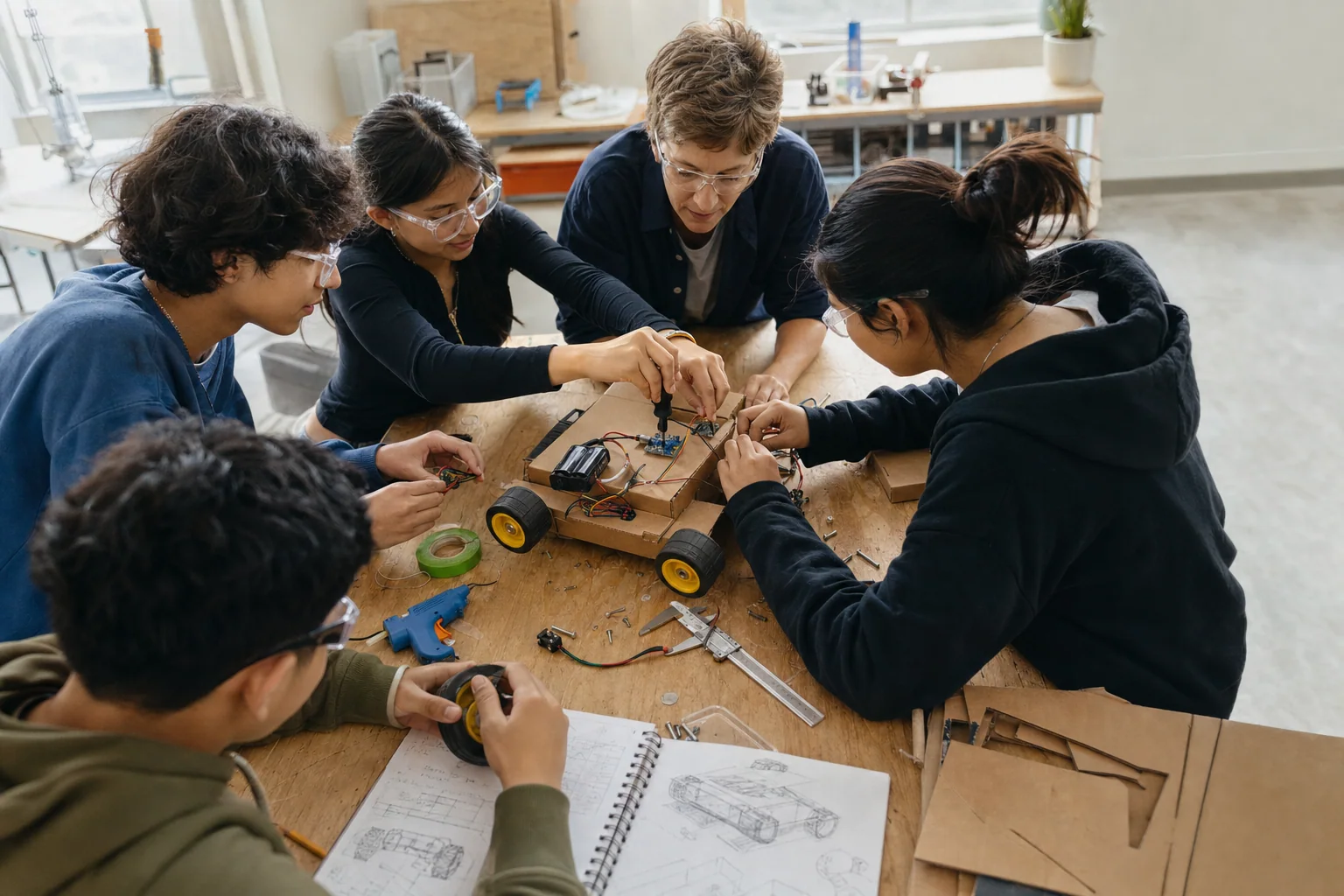
A collaborative student makerspace session around a wheeled prototype
01 / Observe

Anatomy of an invention

45–60 minutes · ages 11+ · pairs or small groups

Choose one product and make its hidden decisions visible.

  1. Select a profile for an object you have used or seen.
  2. List its inputs, outputs, materials and moving or sensing parts.
  3. Draw the product as a system, not just an exterior shape.
  4. Mark the exact contribution attributed to the named inventor.
  5. Write one new constraint a next version should address.
Choose an object
02 / Investigate

Who gets the credit?

60–75 minutes · ages 13+ · groups of 3–4

Compare the public story of a product with its documented team.

  1. Find two profiles connected to the same or related product.
  2. Open every cited attribution source and note the verbs used.
  3. Separate invention, engineering, industrial design and commercialization.
  4. Build a contribution map that preserves shared credit.
  5. Rewrite a “lone genius” headline as an evidence-based sentence.
Use the attribution rule
03 / Evaluate

Evidence under pressure

45–90 minutes · ages 15+ · individual or group

Audit a profile as if it were about to be published.

  1. Assign each source to attribution, impact or living status.
  2. Check whether the linked page supports the exact wording.
  3. Identify first-party, independent and archival evidence.
  4. Look for identity confusion, team overclaim or company-only credit.
  5. Deliver a verdict: publish, revise or remove—and explain why.
Open the source library

Adapt the rigor, not the curiosity.

For younger learners, supply one preselected profile and focus on observation and diagramming. For advanced learners, require an additional independent source and a written attribution judgment.

Every activity can end with a prototype: change one constraint, sketch the mechanism and explain what evidence would demonstrate that the new design works.